How to Map Your Parts: Making Sense of Your Inner World
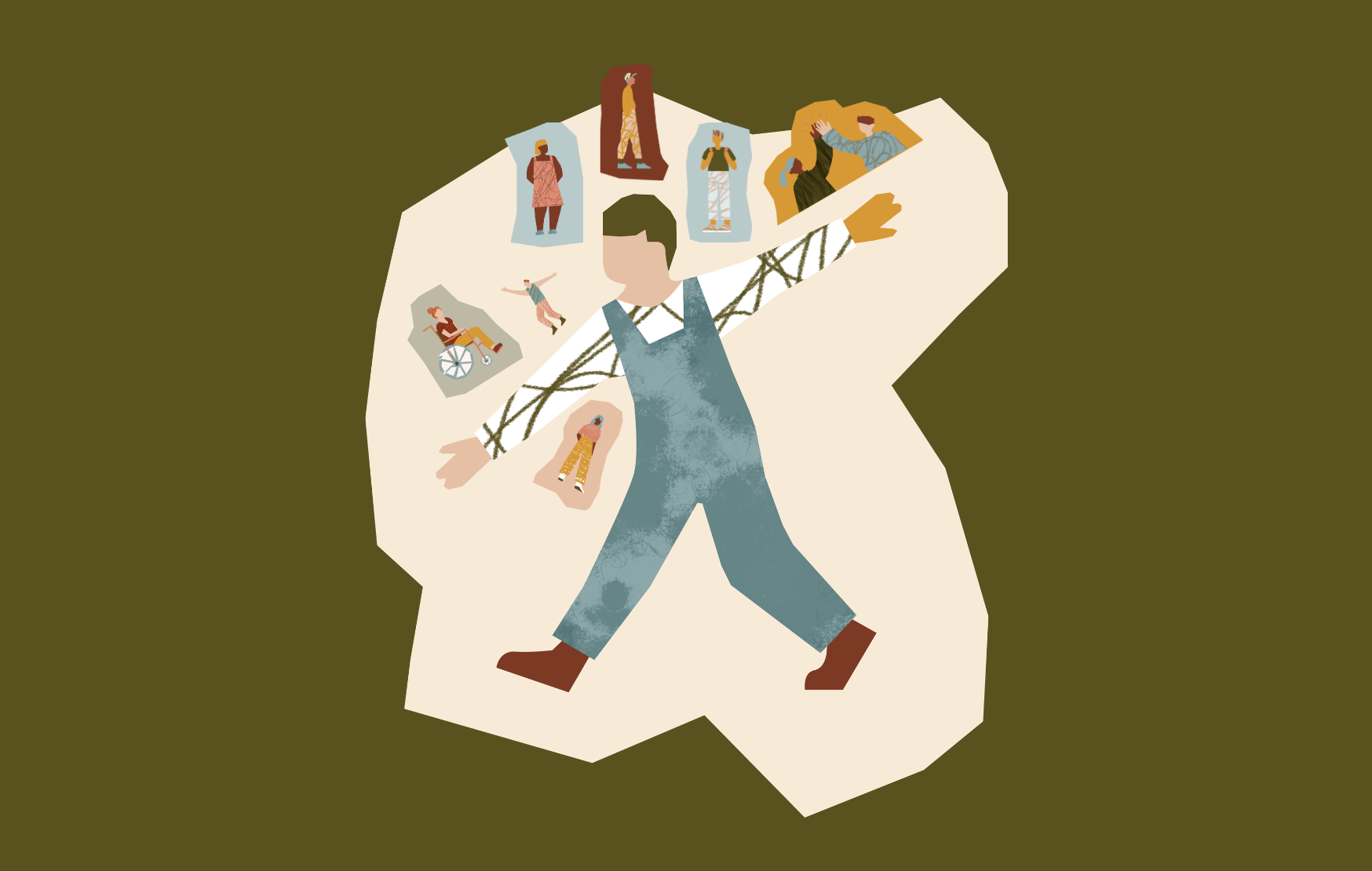
A practical, research-informed guide to understanding the different “you’s” inside your brain.
Have you ever noticed that part of you genuinely wants to go to bed early… while another part somehow opens TikTok and suddenly it is midnight?
Or one part of you feels calm, reflective, and insightful in therapy, while another panics the second you have to send a mildly vulnerable email?
If so, congratulations. You are having a very normal human experience.
Psychology is increasingly moving away from the idea that we have one single, consistent inner voice. Instead, many modern approaches understand the mind as a system made up of different parts, each with its own feelings, motivations, memories, and protective roles.
Internal Family Systems (IFS) therapy helped make this language popular, but the idea itself is supported by decades of neuroscience, attachment research, and psychological theory.
The reassuring part is this.
You do not need to be in therapy to start understanding your own inner system. You can begin mapping your parts yourself, with curiosity, kindness, and absolutely no requirement to get it perfect.
Let’s start there.
First: What Do We Mean by “Parts”?
In IFS therapy, developed by Richard Schwartz, parts are understood as different inner subpersonalities that help us navigate life.
They are not disorders.
They are not signs that something is broken.
They are normal ways human brains organise experience.
IFS often describes three broad categories:
Managers: These parts try to keep life predictable and safe. They plan, organise, achieve, analyse, and sometimes overthink at 2am in an attempt to prevent future problems.
Firefighters: These parts step in when emotions feel overwhelming. Their job is fast relief. That might look like scrolling, avoiding, numbing out, or suddenly needing snacks and a new TV series immediately.
Exiles (also called the inner child): These are more vulnerable parts that carry hurt, shame, fear, or unmet needs from earlier experiences.
You can think of parts as an internal team trying very hard to protect you, even if their coordination meetings occasionally go off the rails.
One of the most relieving discoveries for many people is this: behaviours that feel confusing or frustrating usually make sense once you understand what a part is trying to protect.
Why This Idea Fits With Neuroscience
IFS language can sound metaphorical at first, but the underlying concept aligns closely with how the brain actually works.
1. The Brain Is Not One System. It Is Many.
Neuroscience shows that different brain networks activate depending on context.
Threat detection systems scan for danger.
Prefrontal networks help with planning and regulation.
Reward systems drive motivation and habits.
Social engagement systems help us feel safe with others.
These systems sometimes cooperate beautifully and sometimes strongly disagree. That is why you can sincerely want opposite things at the same time.
Your brain is less like a single leader and more like a committee where everyone believes they are in charge.
2. Your Brain Is Always Trying to Protect You
Modern neuroscience suggests the brain constantly predicts danger and safety based on past experience.
What we call a “part” is often a learned protection strategy.
“If I stay perfect, I will not be rejected.”
“If I avoid this feeling, I will stay safe.”
“If I disconnect, I cannot get hurt.”
These patterns are not random flaws. They are adaptations shaped by learning and memory.
In other words, your brain is trying to help. Sometimes it is just using very old instructions.
3. We All Shift Between Self-States
Attachment and developmental psychology have long described self-states, meaning different emotional configurations that appear in different relational contexts.
You may notice you are one version of yourself with close friends, another at work, and another when you feel criticised or unsafe.
This is not inconsistency.
It is your nervous system responding intelligently to context.
Why Mapping Your Parts Helps
When people feel stuck, it is rarely because something is fundamentally wrong with them. More often, different parts are pulling in opposite directions.
For example:
A driven part pushes productivity.
A burnt-out part shuts everything down.
A critical part comments loudly on both.
Without awareness, this feels like self-sabotage.
With awareness, it becomes understandable, and often surprisingly compassionate.
Research across therapies shows that self-awareness, emotional labelling, and compassionate reflection improve regulation and reduce distress. Mapping parts naturally builds these skills.
How to Map Your Parts
You do not need special tools. Just curiosity.
Step 1: Notice Inner Contradictions
Start by noticing moments of internal tension.
Try finishing this sentence:
“Part of me wants to ___, and another part of me wants to ___.”
For example:
Part of me wants to rest.
Another part insists I am being lazy.
You have just identified two parts having a disagreement.
Step 2: Name the Parts Gently
Try to avoid harsh or shaming labels.
Instead of “my toxic part,” try something like “the protector that pushes me.”
Naming helps create psychological distance, which research shows supports emotional regulation.
Examples might include:
The Planner
The Overthinker
The Comfort Seeker
The Invisible Kid
The Achiever
You are not diagnosing yourself. You are getting to know your internal landscape.
Step 3: Get Curious About the Job
Ask each part:
What are you trying to help me with?
What are you afraid would happen if you stopped?
When did you first start doing this job?
Here is something many people find surprising.
Even the harsh inner critic usually believes it is protecting you.
Its logic is often, “If I push you hard enough, nothing bad will happen.”
Not kind. But protective.
Step 4: Notice the Body
Parts are not just thoughts. They show up as nervous system states.
Ask yourself:
Where do I feel this part in my body?
A tight chest?
A buzzing mind?
Heavy shoulders?
Connecting awareness to bodily sensation helps regulate the nervous system, which is a core mechanism across many trauma-informed therapies.
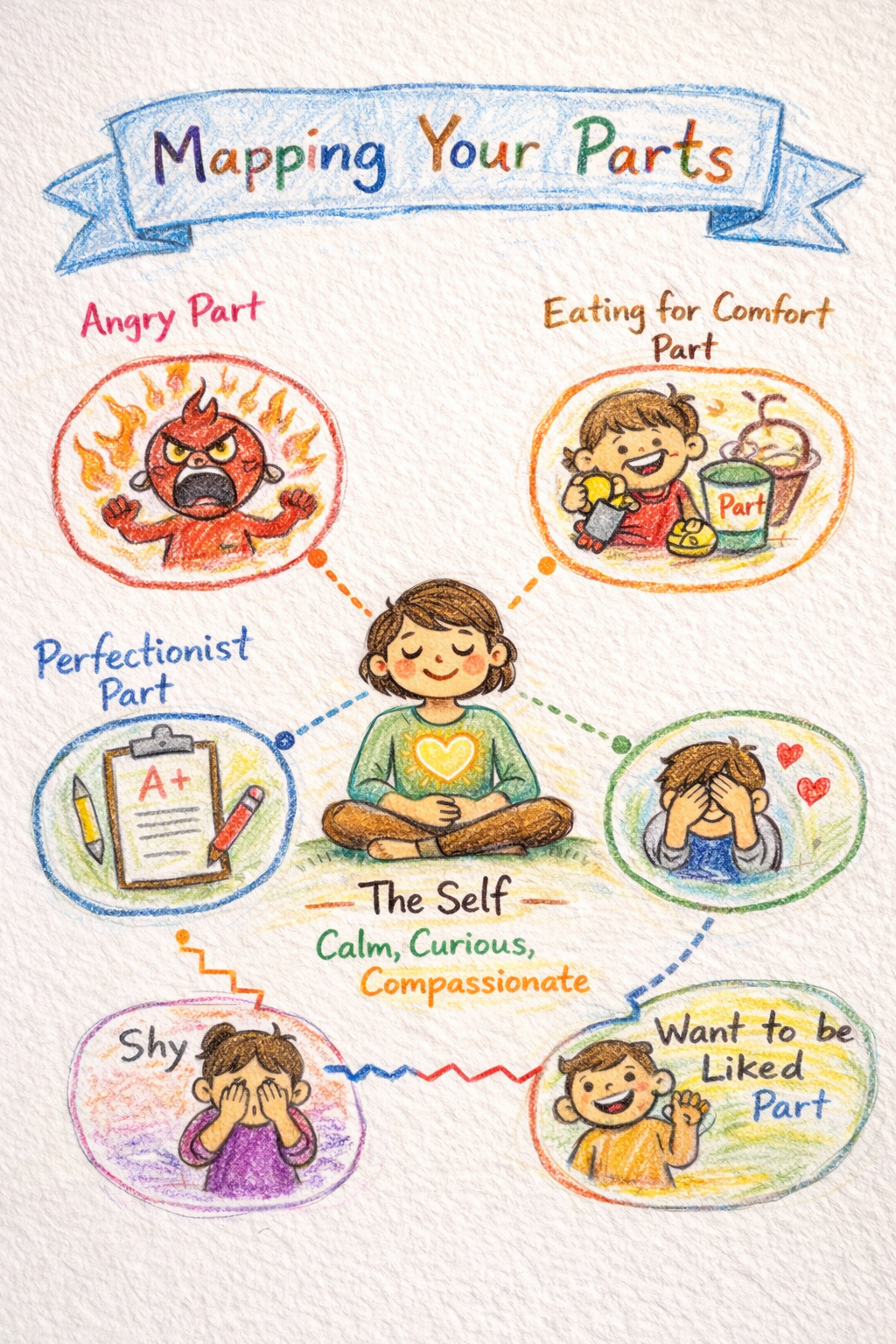
Step 5: Find Your Observing Self
IFS calls this the Self. Other models call it mindful awareness or the observing ego.
It is the part of you that can notice experiences without being completely taken over by them.
You will often recognise this state by how it feels:
curious
calm
compassionate
open
You do not have to force this. Simply noticing parts often creates enough space for this perspective to emerge naturally.
A Quick Example
Let’s say you are procrastinating. Instead of asking, “Why am I like this?” try mapping the parts involved.
The Achiever wants success and approval.
The Overwhelmed Part fears failure.
The Escape Artist scrolls to reduce anxiety.
Suddenly, procrastination looks less like laziness and more like a protection strategy, and compassion becomes possible.
The goal is not to eliminate parts. The goal is to help them feel safe enough to soften.
Most parts relax when they feel understood. Humans tend to work this way too.
A Gentle Starting Exercise
Try this today:
Think of something you feel stuck on.
Write down three different voices or feelings you notice about it.
Thank each one for trying to help, even if you do not agree with its approach.
That is enough.
You have started mapping your internal system.
The Bigger Picture
Across IFS, attachment theory, neuroscience, mindfulness research, and trauma therapy, a shared idea keeps appearing.
Humans heal not through self-control alone, but through self-understanding.
When we stop fighting parts of ourselves, those parts often stop fighting back.
You were never meant to be a single voice.
You were always a conversation.
And learning to listen might be one of the kindest psychological skills you can build.